
Our Repeaters
Mount Climie a well-known high point above Upper Hutt at around 860 m (2,822 feet) elevation. That height and clear line-of-sight over the Hutt Valley and surrounding ranges make it ideal for radio repeaters, which rely on elevation to maximise coverage. This site hosts multiple amateur radio repeaters, with antenna masts, power systems, and huts for sheltering equipment. Being on the Mount Climie Track also means access is possible on foot or by 4WD, though weather conditions up there can be pretty harsh.
Of these, our 730 FM (+ 600 kHz offset) repeater also has an IRLP Node #6713 on it, providing excellent FM voice coverage throughout the lower North Island. Please note that 730's IRLP node number has changed (formerly 6931). 730 is being worked by stations in Blenheim, Nelson, Masterton, Levin, Palmerston North and the Taranaki. A few times in the past, propagation conditions have been such that Australia has worked through 730 along with regular Christchurch and Auckland contacts being reported.
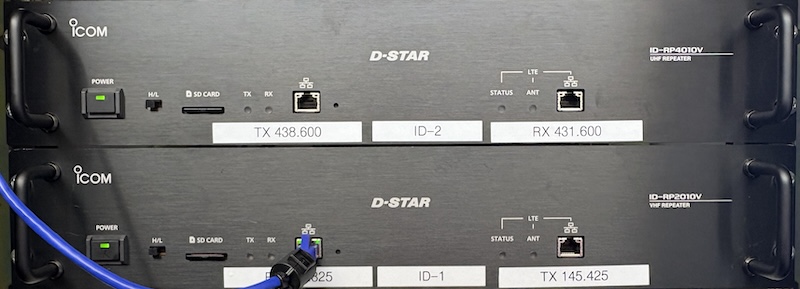
We operate three updated D-Star repeaters using the latest ICOM Repeater hardware (third generation), '5425' , '860' and '1292' which have proved to provide excellent coverage throughout the valley. Find out which repeaters cover your area using our coverage maps.
Repeaters
| Name | TX MHz | Split | Repeater Hardware | Antenna | Power | Mode(s) |
|---|---|---|---|---|---|---|
| 395 6m | 53.950 MHz | -1 MHz [1] | GE Mastr II | ½ wave folded dipole | 70W | FM Voice only |
| 730 2m | 147.300 MHz | +600 kHz | Tait TB7300 | 2 x Dipoles Omni 3 dBd | 50W | FM Voice only |
| D-Star 5425 2m | 145.425 MHz | -600 kHz [2] | ICOM ID-RP2010V | SM-4 dipoles Omni-pattern | 25W | DV/FM & DD |
| D-Star 860 70cm | 438.600 MHz | -7 MHz [2] | ICOM ID-RP4010V | SM-4 dipoles Omni-pattern | 25W | DV/FM & DD |
| 1292 23cm | 1292 MHz | -20 MHz | ICOM ID-RP1200VD | Vertical 6 dBd Coaxial Collinear | 10W | DV/FM & DD |
[1] The 395 (6m) repeater has a 151.4 Hz CTCSS tone on transmit. If you enable this on your transceiver then you will not hear the repeater beaconing.
[2] The D‑Star repeaters 5425 and 860 transmit an FM carrier with a 173.8 Hz CTCSS tone.
If your analogue FM transceiver allows CTCSS (tone squelch) on receive, you can set it to 173.8 Hz.
With tone squelch enabled, your radio will only open its speaker when it detects that 173.8 Hz tone.
Because the D‑Star repeater sends the tone during normal FM transmissions but not during D‑Star digital voice (DV) transmissions, the speaker remains muted during DV activity.
As a result, analogue-only users can monitor the repeater without hearing the harsh digital noise produced by D‑Star signals.
In simple terms, set your analogue radio's receive CTCSS/tone squelch to 173.8 Hz and the radio will ignore D‑Star digital transmissions while still allowing compatible FM transmissions to be heard.
The D-Star repeater '1292' has a 88.5 Hz CTCSS tone on transmit.
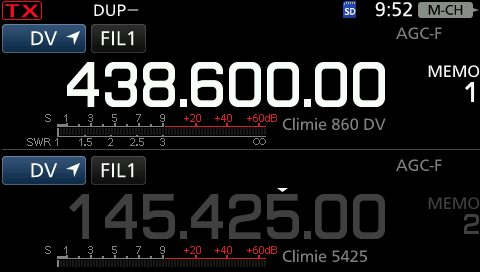
When programming up your ICOM software for FM on the D-Star repeaters - a line for 5425 and 860 should look similar to this, for the Tones to work (the tone for 1292 is 88.5 Hz):
Repeater Resources: Miscellaneous
395 6 metre FM Repeater

730 2 metre FM Repeater

5425 2 metre D-Star/FM Repeater

860 70 cm D-Star/FM Repeater
1292 23 cm D-STAR/FM Repeater

UPDATE (March 2026): Our 23 cm repeater was changed from a Xtal controlled repeater to an RP-1200VD and that is where the problems started. The duplexers.eu MDF1-6-23cm was OK for FM Xtal controlled repeater but I thought we needed a duplexer upgrade to operate the new RP-1200VD. Pedro Wyns ON7WP has proved this is not needed and to try a BPF. We are working the problem and solution will be tried at next site visit.
A fix has been applied and the repeater is now working as expected (May 2026).
We have Icom DV repeaters that needed addition of two BPF's to the VHF repeater. I wrote about this in 2014 The paper shows the duplexer plots. https://zl2vh.nz/assets/pdf/other/5425-overload-solution.pdf. The UHF duplexer was a 8 x cavity and the Icom RP-4000 repeater didn't cause any noise with that duplexer. Our duplexers are higher Q and as can be seen in the plots a nice sharp response with great rejection. https://zl2vh.nz/assets/pdf/other/rp4000-duplexer.pdf
We have now upgraded to RP-2010V and RP-4010V and no issues were heard. So these two repeaters are no worse than the previous older versions and our duplexers work perfectly with these new repeaters.
We will add a paper regarding the RP-1200VD noise solution later, once de-sense is eliminated.
It pays to purchase the best quality and highest Q if building a repeater from new. RF Grounding (Earthing) is also most important.
We know about other clubs in New Zealand that used a mobile (small size) duplexer on an RP-4000 and it cannot be used above 2.5 watts TX power without de-sense. Just useless so using larger cavity filters, like our club has done, is the only way to go especially on VHF / UHF with closer splits.
I say no to any mobile duplexers if you want to run more than 5 watts on VHF / UHF however with the RP-1200VD being 10 watts and we currently use a -20 MHz split I'm confident in achieving a usable result after fitting a BPF to the TX port.
Australia has just published it's new 23 cm band plan and now offers an offset split of -40 and -41 MHz. New Zealand authority (RSM) has not advised what restrictions will be placed on us resulting from IRU 5.332A rule relating to possible QRM to the GNSS satellite system.
When RSM advise us we hope to be like Australia and be treated as a legacy repeater. Thereby retaining our currently used -20 MHz frequency pair. However if pair is moved then the split of -40 MHz and -41 MHz will help further. We use a coaxial collinear vertical whip antenna so 40 MHz split will still be usable.
73, John ZL2TWS
Repeater Trustee